IBD Shorts: Ustekinumab in Kids, Subcutaenous Infliximab, Nutrition Highlights

MT Dolinger et al. J Crohns Colitis 2022.  doi: 10.1093/ecco-jcc/jjac055. Online ahead of print. Outcomes of Children With Inflammatory Bowel Disease Who Develop Anti-Tumor Necrosis Factor Induced Skin Reactions

In this retrospective study, among those who developed skin reactions to anti-TNF agents, 71 (64%) continued anti-TNF and 40 (36%) switched to ustekinumab (UST). Key findings:

  • Switching to UST had a higher rate and odds of resolution of skin findings (29/40 (73%) vs. 24/71 (34%); p <0.0001) and combined remission (21 (52%) vs. 22 (31%); p=0.03) vs. continuing anti-TNF at 6 months

PJ Smith et al. J Crohns Colitis, jjac053, https://doi.org/10.1093/ecco-jcc/jjac053 Open Access: Efficacy and Safety of Elective Switching From Intravenous to Subcutaneous Infliximab (Ct-P13): A Multi-Centre Cohort Study

Patients (n=181) on established maintenance IV infliximab who switched to SC CT-P13 were included in this retrospective multi-centre cohort study. Key findings:

  • Treatment persistence rate was high (N=167, 92.3%) and only 14 patients (7.7%) stopped treatment during the follow-up period. There were low rates of immunogenicity with no change in clinical disease activity indices or biomarkers

Link: Crohn’s and Colitis Congress 2022 Nutritional Highlights (Nutritional Therapy for IBD Website). This website has a summaries, and links to extensive information (videos/posters) from recent IBD meeting.

Sunrise in Sandy Springs (4/9/22) -no filter

IBD and Chronic Recurrent Multifocal Osteomyelitis: Paradoxical Association with anti-TNF Therapy in Some Cases

MJ Dushnicky et al. JPGN 2021; 73: 626-629. Pediatric Patients with a Dual Diagnosis of Inflammatory Bowel Disease and Chronic Recurrent Multifocal Osteomyelitis

This article describes a retrospective review of seven patients with a dual diagnosis of inflammatory bowel disease (IBD) and chronic recurrent multifocal osteomyelitis (CRMO). In their cohort 4 of 6 were receiving anti-TNF therapy at the time of CRMO diagnosis. Misleading statements from this article:

  1. The triad of IBD, CRMO and psoriasis has not been reported previously to their knowledge
  2. “It seems unlikely that anti-TNF-alpha therapy would promote its [CRMO] development”

In JPGN Reports (not available on pubmed), Cordesse et al (JPGN Reports; November 2020 – Volume 1 – Issue 2 – p e007) identified the association of IBD, CRMO and psoriasis; in addition, they identified a paradoxical reaction to anti-TNF-alpha therapy; in this case series of three patients, anti-TNF-alpha therapy triggered CRMO and stopping anti-TNF-alpha therapy led to resolution of CRMO in two of the cases.

In a response to a letter to the editor (Hochman JA. JPGN 2022; DOI: 10.1097/MPG.0000000000003407. Faulty Information Regarding CRMO and IBD), Dushnicky et al (DOI: 10.1097/MPG.0000000000003433) note that JPGN Reports is not available on Pubmed; however, the articles that have described this association are near the top of a google search if one looks for “IBD, CRMO and Psoriasis.” Interestingly, in their response to the letter to the editor, the authors did not amend their claim that anti-TNF therapy is unlikely to promote CRMO despite being furnished with information showing that it can. In my view, the situation with CRMO is similar to psoriasis which can be treated with anti-TNF therapy and can paradoxically be caused by anti-TNF agents as well.

My take:

  1. CRMO is important to recognize due to its association with IBD and to realize that antibiotics are not an effective treatment.
  2. Anti-TNF-alpha agents can cause CRMO in some patients.
  3. In 2022, a web browser search (eg Google), in addition to Pubmed, is probably worthwhile when claiming that this is the first case of xyz ‘to our knowledge.’
Bahamas (from a friend)

Early Antibiotics -Minimal Risk for Crohn’s Disease

Previous studies have shown an association between the early use of antibiotics and an increased risk of inflammatory bowel disease. A recent study examined all the children born in Denmark from 1995-2009 and followed them up to 2013 via a prospectively maintained database.

A Mark-Christensen et al. Inflamm Bowel Dis 2022; 28: 415-422. Early-Life Exposure to Antibiotics and Risk for Crohn’s Disease: A Nationwide Danish Birth Cohort Study 

During a median 9.5 years (9.3 million total person-years), CD was diagnosed in 208 of 979,039 children.

Key findings:

  • Antibiotic use in the first year of life was associated with a higher risk of CD (adjusted hazard ratio, 1.4)…with the highest risk with ≥6 courses of antibiotics (adjusted hazard ratio, 4.1)
  • The cumulative risk of CD at the 11th birthday for children exposed to antibiotics in their first year of life was 0.16% compared to 0.11% for children unexposed to antibiotics in their first year of life. 

My take: This study indicates that antibiotics (and/or serious infections) are associated with an increased the risk of pediatric Crohn’s disease but the absolute risk is very low. We still have a lot to learn about how environmental exposures, including diet, infections, antibiotics, and pollution, contribute to the increasing prevalence of inflammatory bowel disease.

Related blog posts:

From Atlanta Botanical Gardens -Thanks to Jennifer for this picture

What is An Emulsifier and Are They Safe in Our Diets?

Two recent articles examine emulsifiers and their potential impact on the GI tract and beyond.

Levine et al provide a good overview of the topic of emulsifiers. Key points:

  • Emulsifiers allow “the mixing of water and and water-soluble agents with fats and fat-soluble agents that is they possess both hydrophilic and lipophilic properties”
  • The FDA “has been responsible for approving the use of all direct food additives” (n=~3000) and “for regulatory purposes, [the FDA excluded] some substances that were generally regarded as safe (GRAS) (n=~450)…Precisely how some emulsifiers gained GRAS status is unclear.
  • “Lecithin” is derived from the Greek name for egg yolk (lekithos). “Over the years the use of the term “lecithin” has been taken to include various mixtures of different phospholipids” (not just phosphatidylcholine).
  • Lecithin can provide the substrate “for the production of trimethylamine N-oxide (TMAO)…linked to cardiac events and cardiovascular inflammation.”
  • “The list of emulsifiers that are widely used, but not considered GRAS, most notably include polysorbate 80 (p80), carboxymethylcellulose (CMC) and carrageenan…these emulsifiers have been linked to the disruption of the microbiota and gut mucosal lining…In addition, low-grade inflammation [has been] associated with consumption of emulsifying agents such as CMC and p80” [in mouse models].
  • The International Organization for the Study of Inflammatory Bowel Disease (IOIBD) has recommended that IBD patients “limit consumption of certain commonly encountered synthetic emulsifiers, specifically carboxymethylcellulose (E466/cellulose gum) and polysorbate 80 (E433) [which] are present in many processed foods, such as ice cream. The group also recommends a decrease in foods containing carrageenan”

In the second study by Chassaing et al with 16 healthy adults, the authors studied the effects of CMC in those with an emulsifier-free diet (n=9) or an identical diet enriched with CMC (n=7).

Key findings:

  • Relative to control subjects, CMC consumption modestly increased postprandial abdominal discomfort and perturbed gut microbiota composition in a way that reduced its diversity
  • CMC-fed subjects exhibited changes in the fecal metabolome, particularly reductions in short-chain fatty acids and free amino acids
  • 2 subjects consuming CMC who exhibited increased microbiota encroachment into the normally sterile inner mucus layer, a central feature of gut inflammation, as well as stark alterations in microbiota composition

My take: The dramatic increase in the prevalence of IBD over the past 50 years indicates a strong influence of environment factors, particularly diet. Determining which of these factors are most important will be challenging. These articles indicate that some emulsifiers could be contributing to GI tract inflammation and non-GI tract inflammation as well.

The challenges with identifying dietary factors relate to difficulties with using randomized controlled trials (especially eliminating delicious foods) to assess the impact over a long period of follow-up.

Related blog posts:

New Therapy for Crohn’s Disease: Mirikizumab

Because our office is one of the centers participating in a mirikizumab study for adolescents, I was particularly interested in seeing the published results of a phase 2 study in 191 adults.

BE Sands et al. Gastroenterol 2022; 162: 495-508. Open Access: Efficacy and Safety of Mirikizumab in a Randomized Phase 2 Study of Patients With Crohn’s Disease

Summary Video Link (worth a watch!): Summary of Mirikizumab Study (4:25 minutes)

Background: “Mirikizumab (LY3074828) is a humanized immunoglobulin G4 (IgG4)–variant monoclonal antibody that binds specifically to the p19 subunit of IL23 and has demonstrated efficacy in psoriasis and ulcerative colitis, and is currently in phase 3 testing for psoriasis, ulcerative colitis, and CD. We evaluated the efficacy and safety of mirikizumab for the treatment of patients with moderately-to-severely active CD”

Methods: Patients (N = 191) were randomized (2:1:1:2) to receive placebo (PBO), 200, 600, or 1000 mg mirikizumab, administered intravenously (IV) every 4 weeks. Patients who received mirikizumab and achieved ≥1 point improvement in Simple Endoscopic Score-CD at Week 12 (rerandomized maintenance cohort) were rerandomized to continue their induction IV treatment (combined IV groups [IV-C]) or receive 300 mg mirikizumab subcutaneously (SC) every 4 weeks. Nonrandomized maintenance cohort included endoscopic nonimprovers (1000 mg) and PBO patients (PBO/1000 mg) who received 1000 mg mirikizumab IV from Week 12. The primary objective was to evaluate superiority of mirikizumab to PBO in inducing endoscopic response (50% reduction from baseline in Simple Endoscopic Score-CD) at Week 12.

**approximately two thirds of participants had received biologic therapy and approximately half of all patients in this trial having experienced at least 1 biologic failure

Key findings:

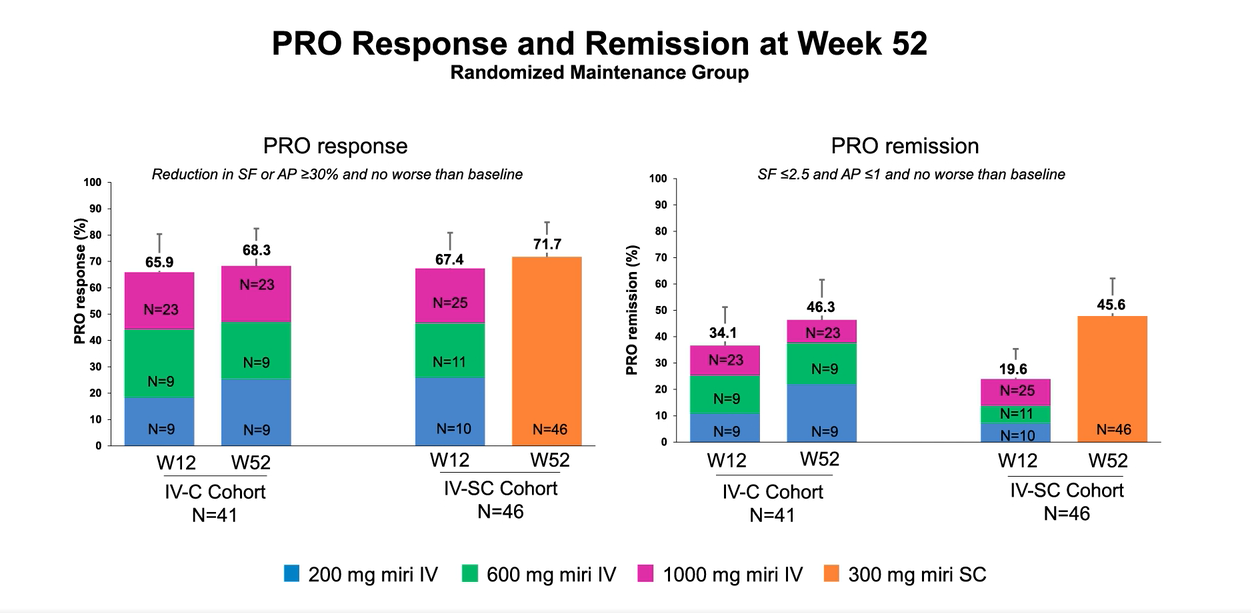
  • At Week 12, endoscopic response was significantly higher for all mirikizumab groups compared with placebo (PBO) (200 mg: 25.8%, P = .079; 600 mg: 37.5%, P = .003; 1000 mg: 43.8%, P < .001; PBO: 10.9 %). 
  • Endoscopic response at Week 52 was 58.5% (24/41) and 58.7% (27/46) in the IV-C (combined IV groups) and SC (subcutaneous) groups , respectively. See 4th and 6th slides below which show that those with response at 12 weeks continued with response at 52 weeks.
In the Non-Randomized group which included non-improvers and placebo, they received
the highest dose, 1000 mg. A significant number of non-improvers responded at week 52.

My take: In this study of adults, with moderate to severe Crohn’s disease, Mirikizumab showed good efficacy and safety at both 12 weeks and 52 weeks. Because about half of the participants were biologic failures, this indicates that this agent shows promise in those with refractory disease.

NASPGHAN 2021 Nutrition Highlights

Thanks to Kipp Ellsworth for forwarding this link:

Nutrition for IBD website: NASPGHAN 2021 Nutritional Highlights

On this website: “Four presentations/lectures were released at the Nutritional Therapy for IBD Virtual Booth that provide a comprehensive review and update of the latest information regarding the use of EEN and therapeutic diets in the management of IBD”

Why Do We Need Dietary Therapies for IBD

Presenter: Lindsey Albenberg, DO

Dr. Lindsey Albenberg, a clinician and researcher from Children’s Hospital of Philadelphia, describes the rapidly increasing incidence of IBD and its relationship to diet, microbiome and the immune system. She reviews the rationale and science supporting the use of dietary therapy to compliment drug therapy as an avenue to potentially achieve higher, more sustainable and possibly safer levels of remission long term in pediatric patients.

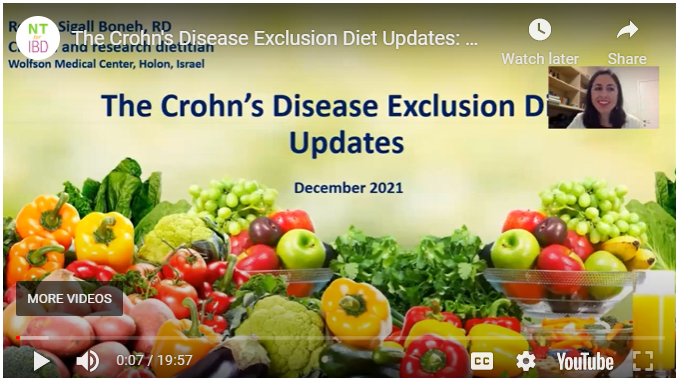
The Crohn’s Disease Exclusion Diet Updates: December 2021

Presenter: Rotem Sigall Boneh, RD. Rotem Sigall Boneh, RD, a primary researcher and developer of CDED, provides an overview of the accumulating data with CDED in combination with PEN, including the newly published results of adult data with important endoscopic findings and further shares real world experience and application of nutritional therapy.

IBD Anti-inflammatory Diet or IBD-AID: Proof of Concept

Presenter Ana Maldonado-Contreras, MSc, PhD. Dr. Ana Maldonado-Contreras, a lead researcher in IBD-AID explains the relationship between diet, microbiome and immune function with the design and rational of IBD-AID to manipulate the microbiome. She shares the recently published data of the impact of IBD-AID on the microbiome and cytokine levels specific to food components.

Nutritional Therapy: Perioperative + Complicated Crohn’s Disease

Presenter Andrew S. Day, MB, ChB, MD, FRACP, AGAF

At the NTforIBD Nutritional Symposium prepared for NASPGHAN2021, Professor Day provides insight into the important role of EEN, an underutilized option to both induce remission and improve outcomes in complicated and peri-operative patients.

IBD Shorts: Fecal Calprotectin in UC & Medication Withdrawal, Outcome of Biosimilar Reverse Switches, Vedolizumab after Anti-TNF Therapy

TW Stevens et al. Inflamm Bowel Dis 2021; 19: 2333-2342. Open Access. Diagnostic Accuracy of Fecal Calprotectin Concentration in Evaluating Therapeutic Outcomes of Patients With Ulcerative Colitis

Key finding: A post hoc analysis of data from a phase 4 trial (the MOMENTUM trial) found that, even in patients (n=593 at week 8, n=305 at week 52) with complete endoscopic healing of UC, FC concentration can be used to discriminate patients with ongoing microscopic inflammation from patients with histologic remission.  The optimal FC cut-off concentrations for identification of patients with histologic remission were 75 μg/g at week 8 and 99 μg/g at week 52.

A Cassinotti et al. Clin Gastroenterol Hepatol 2021; 19: 2293-2301. Noninvasive Monitoring After Azathioprine Withdrawal in Patients With Inflammatory Bowel Disease in Deep Remission

Key finding: In this prospective study, 57 patients in deep remission stopped azathioprine after a median of 7 years. 26 (46%) relapsed within a median of 15 months. Fecal calprotectin (FC) levels were >50 mcg/g in all patients with relapse (FC specificity 100%) but the sensitivity was only 50%. Thus, having a normal FC does not preclude relapse but elevated FC is associated with relapse.

S Mahmmod et al. Inflamm Bowel Dis 2021; 27: 1954-1962. Outcome of Reverse Switching From CT-P13 to Originator Infliximab in Patients With Inflammatory Bowel Disease

In this retrospective study, 75 patients, 9.9% of all patients, who had been changed from originator infliximab to a biosimilar had clinical worsening. Key finding: Improvement of reported symptoms was seen in 73.3% of patients after reverse switching back to originator infliximab; alsor 7 out of 9 patients (77.8%) with loss of response regained response

J Kim et al. Inflamm Bowel Dis 2021; 27: 1931-1941. Clinical Outcomes and Response Predictors of Vedolizumab Induction Treatment for Korean Patients With Inflammatory Bowel Diseases Who Failed Anti-TNF Therapy: A KASID Prospective Multicenter Cohort Study

Key finding: Clinical remission rates with vedolizumab among patients with CD (n=80) and patients with UC (n=78) were 44.1% and 44.0%. Among patients with UC, the endoscopic remission rate was 32.4%

Favorite Posts of 2021

I am happy to say that this is the last nightcall that I will have this year!

Today, I’ve compiled some of my favorite posts from the past year. I started this blog a little more than 10 years ago. I am grateful for the encouragement/suggestions from many people to help make this blog better. Also, I want to wish everyone a Happy New Year.

GI:

IBD:

LIVER:

Nutrition:

Other Topics:

Thanks to Jennifer

Preclinical Disease Detection of Inflammatory Bowel Disease

Recent articles indicate the possibility of preclinical disease detection of inflammatory bowel disease; perhaps this is analagous to the “precrime’ detection in The Minority Report which allowed the police to arrest people before they committed their crime.

D Bergemalm et al. Gastroenterol 2021; 161: 1526-1539. Open Access: Systemic Inflammation in Preclinical Ulcerative Colitis

In this study from Sweden, the authors used biobanked plasma samples from 72 individuals with ulcerative colitis (UC) and matched healthy controls (n=140). Then the findings were validated in an inception cohort (n=101 with UC and 50 healthy controls. In addition, a cohort of heathy twin siblings of patients with UC (n=41) were matched with healthy controls (n=37).

Key findings:

  • Six proteins (MMP10, CXCL9, CCL11, SLAMF1, CXCL11 and MCP-1) were up-regulated (P < .05) in preclinical ulcerative colitis compared with controls
  • MMP10, CXCL9, CXCL11, and MCP1, but not CCL11 and SLAMF1, were significantly up-regulated among the healthy twin siblings. This up-regulation is triggered by exposure to genetic and early environmental factors.

The discussion elaborates on the role of these proteins.

  • MMP10 is classified as a stromelysin. Upregulated levels of stromelysin have been detected in inflamed segments of the colon from patients with ulcerative colitis….The observed preclinical upregulation of MMP10 [thought to promote wound healing] in plasma might indicate that endogenous pathways for wound healing are up-regulated several years before clinically overt ulcerative colitis to counteract disease progression and maintain mucosal homeostasis”
  • “Eotaxin (CCL11) is a potent chemoattractant of monocytes…eosinophilic-driven inflammation represents an early element in the pathogenesis of ulcerative colitis”
  • CXCL9 and CXCL11 has been observed previously in inflamed colonic tissue specimens and blood from patients with ulcerative colitis… Both chemokines are regulated by IFN-gamma and attract CXCR3-positive CD4þ T cells and natural killer cells to the inflammatory site”

My take: This study shows up-regulation of 6 plasma proteins indicating activation of both pro-inflammatory and tissue-repairing pathways several years before clinically overt UC. It offers hope of intervention to prevent the development of UC.

Related study: S-H Lee et al. Gastroenterol 2021; 161: 1540-1551. Open Access: Anti-Microbial Antibody Response is Associated With Future Onset of Crohn’s Disease Independent of Biomarkers of Altered Gut Barrier Function, Subclinical Inflammation, and Genetic Risk

In this study, the authors measured host serum antibody response to 6 microbial antigens at enrollment (Prometheus enzyme-linked immunosorbent assay test: anti-Saccharomyces cerevisiae antibodies immunoglobulin A/immunoglobulin G, anti-OmpC, anti-A4-Fla2, anti-FlaX, anti-CBir1) and derived the sum of positive antibodies (AS).

Key finding:

“High baseline AS (≥2) (43% of cases, 11% of controls) was associated with higher risk of developing CD (adjusted odds ratio, 6.5; 95% confidence interval, 3.4–12.7; P < .001). Importantly, this association remained significant when adjusted for markers of gut barrier function, fecal calprotectin, C-reactive protein, and CD-polygenic risk score, and in subjects recruited more than 3 years before diagnosis. Causal mediation analysis showed that the effect of high AS on future CD development is partially mediated (42%) via preclinical gut inflammation.

Dietary Therapy for Adults with Crohn’s Disease

H Yanai et al. The Lancet 2021; The Crohn’s disease exclusion diet for induction and maintenance of remission in adults with mild-to-moderate Crohn’s disease (CDED-AD): an open-label, pilot, randomised trial https://doi.org/10.1016/S2468-1253(21)00299-5

In this open-label trial of adults with mild-to-moderate biologic naive Crohn’s disease, key findings:

  • At week 6, 13 (68%) of 19 patients in the CDED plus partial enteral nutrition group and 12 (57%) of 21 patients in the CDED group had achieved clinical remission (p=0·4618)
  • Among the 25 patients in remission at week 6, 20 (80%) were in sustained remission at week 24 (12 patients in the CDED plus partial enteral nutrition group and eight in the CDED alone group)
  • 14 (35%) of 40 patients were in endoscopic remission at week 24 (eight patients in the CDED plus partial enteral nutrition group and six in the CDED alone group)

My take: Dietary therapy may be effective option for motivated adult patients with Crohn’s disease.

Related blog posts: