Landmark Dupilumab Study for Eosinophilic Esophagitis

ES Dellon et al. NEJM 2022; 387; 2317-2330. Dupilumab in Adults and Adolescents with Eosinophilic Esophagitis

This study was pivotal for receiving FDA approval of dupilumab (dupixent) for the treatment of EoE (the only FDA approved therapy). Background: “Dupilumab, a fully human monoclonal antibody, blocks interleukin-4 and interleukin-13 signaling, which have key roles in eosinophilic esophagitis..Standard-of-care treatments for eosinophilic esophagitis include food elimination diets, proton-pump inhibitors (PPIs), swallowed topical glucocorticoids (applied to the esophagus by swallowing), and, in the case of strictures, esophageal dilation.11,12 However, the rates of response are variable (30 to 40% of patients may not have a response to first-line treatments).”

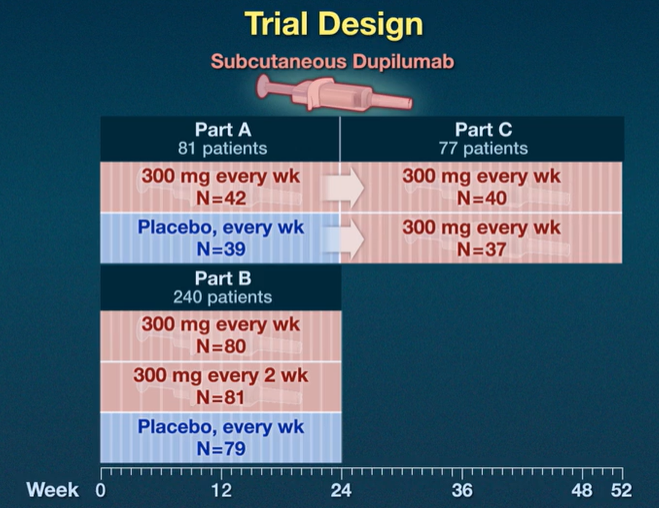
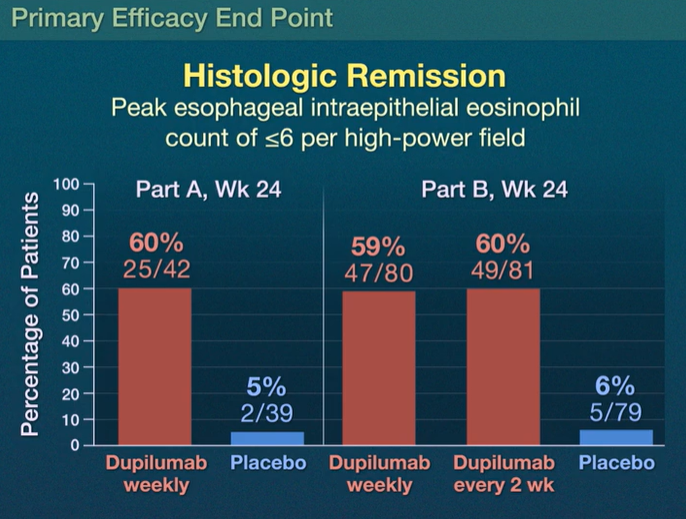
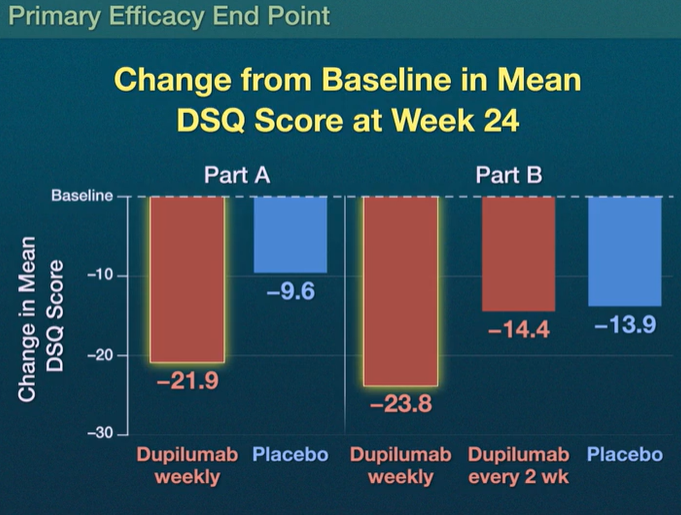
Key findings from three-part study (see images below):

  • Part A: Histologic remission occurred in 25 of 42 patients (60%) who received weekly dupilumab and in 2 of 39 patients (5%) who received placebo
  • Part B: Histologic remission occurred in 47 of 80 patients (59%) with weekly dupilumab, in 49 of 81 patients (60%) with dupilumab every 2 weeks, and in 5 of 79 patients (6%) with placebo 
  • Dysphagia Symptom Questionnaire (DSQ) scores:  the scores improved with weekly dupilumab as compared with placebo, with differences of –12.32 (95% CI, –19.11 to –5.54) in Part A and –9.92 (95% CI, –14.81 to –5.02) in Part B (both P<0.001) but not with dupilumab every 2 weeks (difference in Part B, –0.51; 95% CI, –5.42 to 4.41)
  • The most common adverse effect was injection site reactions. There were 10 serious adverse events; none of these “were considered by the trial investigators to be related to the trial regimen.”

In the associated commentary, (pg 2379-2380), Dr. Alex Straumann notes that since EoE is localized to the esophagus, whether a patients should be treated with a systemically acting medication, “particularly in light of the fact that topical glucocorticoids have been shown to be as efficacious as systemically acting prednisone.”

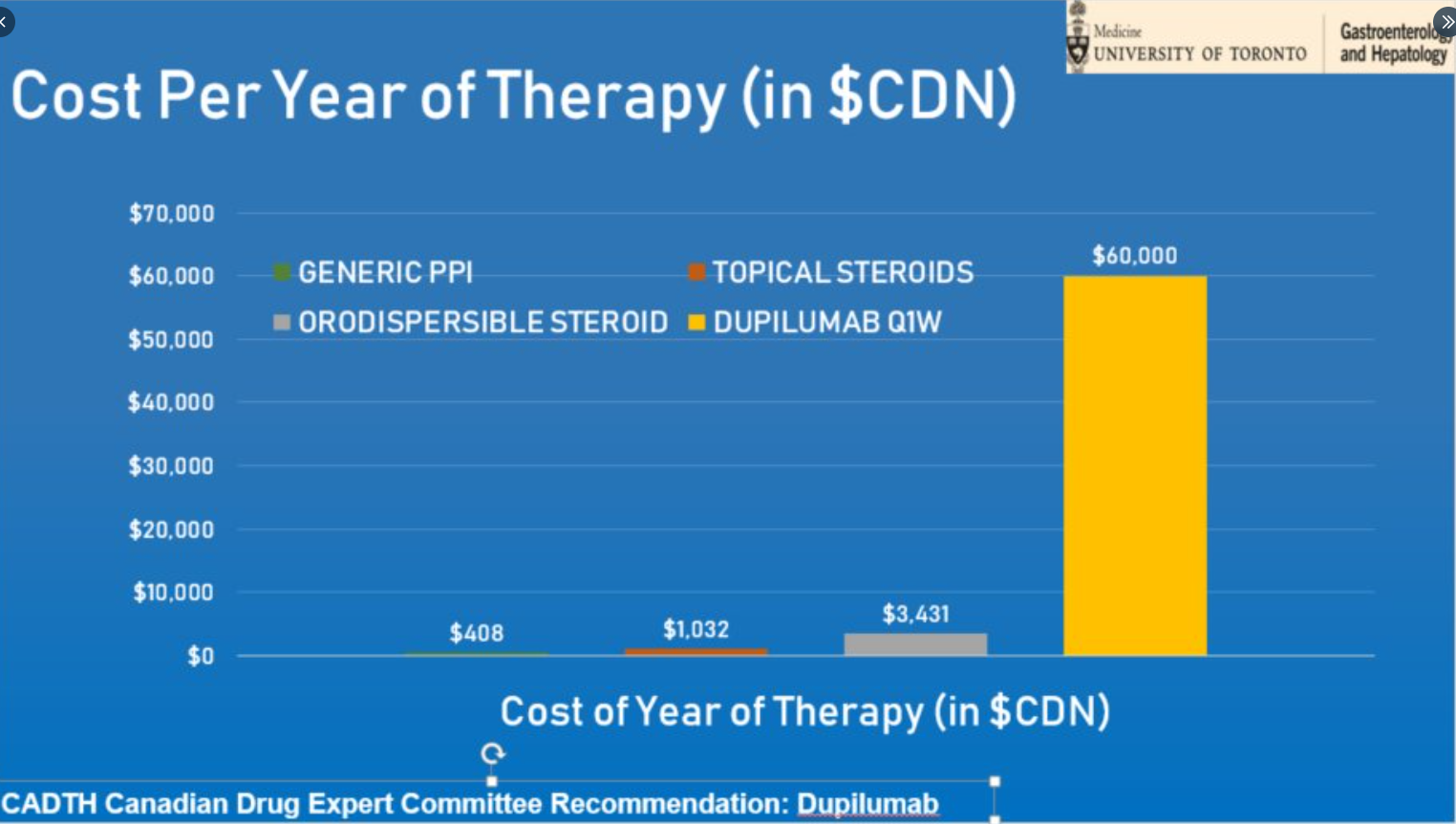
My take (borrowed in part from editorial): It remains unclear whether dupilumab “is better than the good old topical glucocorticoids in improving disease outcomes, particularly in light of considerable costs associated with this treatment.” Due to its cost (see below), dupillumab is likely best situated as a 2nd line treatment at this time for most patients.

Related blog posts:

Cost comparison (from Laura Targownwik on twitter):

Favorite Posts 2022

Thank you to those who have helped me this past year with this blog –colleagues, friends and family. Wishing all of you a good 2023. Here are some of my favorite posts from this past year:

GI:

Nutrition:

Liver:

Endoscopy:

Health Policy:

Humor:

Updated Nomenclature for Eosinophilic Gastrointestinal Diseases

ES Dellon et al. Clin Gastroenterol Hepatol 2022; 20: 2474-2484. Open Access! International Consensus Recommendations for Eosinophilic Gastrointestinal Disease Nomenclature

This article has 91 authors! Using Delphi surveys, the authors recommend the following:

  • “EGID” was the preferred umbrella term for disorders of gastrointestinal (GI) tract eosinophilic inflammation in the absence of secondary causes
  • Involved GI tract segments will be named specifically and use an “Eo” abbreviation convention: eosinophilic gastritis (now abbreviated EoG), eosinophilic enteritis (EoN), and eosinophilic colitis (EoC)
  • For EoN, “it is desirable, but not required, to name specific locations of small bowel involvement, if these are known…The abbreviation for eosinophilic duodenitis should be “EoD”… for eosinophilic jejunitis should be “EoJ”….eosinophilic ileitis should be “EoI”
  • The term “eosinophilic gastroenteritis” is no longer preferred as the overall name (but can be used to indicate involvement of both the stomach and small bowel)
  • When >2 GI tract areas are involved, the name should reflect all of the involved areas

Newsflash Articles: Untreated Eosinophilic Esophagitis Worsens and the Severely-Damaged Esophagus Does Not Work Well

NC Chang et al. Clin Gastroentol Hepatol 2022; 20: 1701-1708. Open Access! A Gap in Care Leads to Progression of Fibrosis in Eosinophilic Esophagitis Patients

In this retrospective review with 701 patients, 95 (14%) had a gap in care (mean time without care, 4.8 ± 2.3 years). Key findings:

  • Patients post-gap had higher endoscopic severity (2.4 vs 1.5; P < .001) and smaller esophageal diameters (11.0 vs 12.7 mm; P = .04).
  • Strictures were more prevalent with longer gap time (P < .05 for trend). Each additional year of gap time increased odds of stricture by 26%, even after accounting for pre-gap dilation. Additionally, of 67 patients without pre-gap fibrosis, 25 (37%) had at least one fibrotic feature (stricture, narrowing, or requiring dilation) post-gap.

DA Carlson et al. Clin Gastroenterol Hepatol 2022; 20: 1719-1728. Esophageal Dysmotility Is Associated With Disease Severity in Eosinophilic Esophagitis

Consecutive adult patients with EoE (n=199) completed a 16-cm functional luminal imaging probe (FLIP) during endoscopy were evaluated in a cross-sectional study. Key findings:

  • Mucosal eosinophil density was similar between abnormal contractile responses (CRs) and normal CRs (median 34 vs 25)
  • Abnormal CRs more frequently had reduced esophageal distensibility (distensibility plateau <17 mm in 56% vs 32%), with more severe ring scores, and a greater duration of symptoms (median, 10 y vs 7 y)

Thus, abnormal esophageal CRs were related to EoE disease severity, especially features of fibrostenosis. This study suggests that esophageal wall remodeling, rather than eosinophilic inflammatory intensity, was associated with esophageal dysmotility in EoE.

My take: Despite my satirical title, I think these articles are helpful by documenting that ongoing EoE results in worsening esophageal dysfunction/dysmotility (especially if not treated). In addition, they provide insight into the natural history/pathophysiology of EoE.

Related blog posts:

Near Seward, AK. Sea lions and birds flock to this island

How Useful Are 3-site Esophageal Biopsies for Eosinophilic Esophagitis

JB Wechsler et al. Clin Gastroenterol Hepatol 2022; 20: 1971-1976. Defining the Patchy Landscape of Esophageal Eosinophilia in Children With Eosinophilic Esophagitis

Design: The authors prospectively obtained 3-site esophageal biopsies based on rigorous endoscopic measurements of the proximal, mid, and distal esophagus and gastroesophageal junction. Biopsies were reviewed by a pathologist, and those with at least 15 eosinophils per high-power field were considered active EoE.  

Key findings:

  • 304 endoscopies in 167 patients had active EoE. The entire cohort was 217 patients (n=596 endoscopies)
  • Among the 304 endoscopies with active EoE, 9 had focal eosinophilia restricted to the mid esophagus, and 8 were restricted to the proximal esophagus
  • Distal + proximal biopsies had the highest diagnostic sensitivity for a 2-site combination (~98% sensitivity)

Based on this study, the authors recommend “3-site biopsies for optimal disease assessment of active EoE in children.”

My take: I think recommendations to add more and more biopsies is premature until we have evidence that identifying “focal” inflammation in the mid-esophagus has some clinical usefulness/improves outcomes. To me, a 2% increase in sensitivity over 2-site biopsies is negligible & in all likelihood, a 4-site biopsy protocol would increase the yield even further.

Related blog posts:

Stream near Byron Glacier

Eat More Chicken? (for EoE)

JB Wechsler et al. Clin Gastroenterol Hepatol 2022; 20: 1748-1756. A Single-Food Milk Elimination Diet Is Effective for Treatment of Eosinophilic Esophagitis in Children

Design: A prospective observational single-center study in 41 children with EoE treated with the 1-food elimination diet (1FED). Upper endoscopy with biopsies was performed after 8 to 12 weeks of treatment. The primary end point was histologic remission, defined as fewer than 15 eosinophils per high-power field.

Key findings:

  • Histologic remission occurred in 21 (51%) children, with a decrease in peak eosinophils per high-power field from a median of 50
  • Endoscopic abnormalities improved in 24 (59%) patients, while symptoms improved in 25 (61%). Improved symptoms included chest pain, dysphagia, and pocketing/spitting out food
  • Interestingly, in terms of all symptom resolution, this was higher in the group of nonresponders 8 (40%) than in the responders 4 (19%)
  • Younger patients (mean 7 yrs vs 12 yrs) and patients with IgE-mediated food allergies tended to be more likely to fail dairy elimination in this study
  • One key caveat is that most patients continued PPI during study; thus it is unknown if stopping a PPI before starting dairy elimination would have changed treatment response. 90% of patients were receiving PPIs at enrollment

My take: This study should prompt more widespread use of dairy elimination as a first line treatment prior to consideration of medications for long-term treatment. This study also reinforces the concept that symptom improvement remains an inadequate indicator of response. Perhaps, Chick-Fil-A marketing needs to be used for our EoE patients to shun cows (cow’s milk in this case).

Related blog posts:

Kenai Fjords National Park, near Seward Alaska

Long-Term Treatment of Eosinophilic Esophagitis with Budesonide

ES Dellon et al. Clin Gastroenterol Hepatol 2022; 1488-1498. Open access: Long-Term Treatment of Eosinophilic Esophagitis With Budesonide Oral Suspension

Methods: 48 patients who had fully responded to a 12-week induction course of budesonide 2 mg BID oral suspension were randomized to continuation of therapy or to placebo, for 36 weeks.

Key findings:

  • Patients randomized to placebo experienced relapse at a numerically higher rate than those who continued budesonide (43.5% vs 24.0%; p=.13). This reached statistical significance in a per-protocol analysis
  • In a separate arm, 13% of the 106 patients with previous partial or no response did subsequently fully respond to budesonide
  • Budesonide therapy was well-tolerated; candidiasis-related events occurred in 17 patients overall and were mild to moderate, and abnormal adrenocorticotropic hormone stimulation tests were reported in 5%

My take: Most patients who respond to induction with budesonide will continue to respond to ongoing treatment. A high rate of relapse is seen in those randomized to placebo.

Related blog posts:

I-SEE for Eosinophilic Esophagitis

ES Dellon et al Gastroenterol 2022; DOI: https://doi.org/10.1053/j.gastro.2022.03.025 Open Access: A Clinical Severity Index for Eosinophilic Esophagitis: Development, Consensus, and Future Directions “The Index of Severity for Eosinophilic Esophagitis (I-SEE)—that can be completed at routine clinic visits to assess disease severity using a point scale of 0–6 for mild, 7–14 for moderate, and ≥15 for severe EoE.”

From AGA: Eosinophilic Esophagitis Index

“The Index of Severity for EoE (I-SEE) is now available for you to use as a tool to help assess EoE patients. Developed by a multidisciplinary team of experts, the new tool is now published in Gastroenterology.

Details about I-SEE 

  • “The I-SEE has three domains: (1) symptoms and complications, (2) inflammatory features and (3) fibrostenotic.
  • I-SEE can be used at initial diagnosis and then at each subsequent visit, with the recall being only between visits so that the severity can be assessed over time and ultimately (when data supports this step) treatment and monitoring adjusted based on severity.
  • As the number of children and adults with EoE increases worldwide, a simple system to assess and track disease activity in a meaningful way in a clinical setting is needed.
  • I-SEE is for use in adult and pediatric patients with EoE. It was created by an international team of more than 30 experts in allergy, gastroenterology and pathology.”

Link: I-SEE Tool Scoring Table

Two Studies for Eosinophiles

ES Dellon et al. Clin Gastroenterol Hepatol 2022; 20: 535-545. Open Access: Determination of Biopsy Yield That Optimally Detects Eosinophilic Gastritis and/or Duodenitis in a Randomized Trial of Lirentelimab

Key findings:

  • GI eosinophilia was patchy and that examination of multiple biopsies was required for diagnosis—an average of only 2.6 per 8 gastric biopsies and 2.2 per 4 duodenal biopsies per subject met thresholds for EG/EoD.
  • Evaluation of multiple nonoverlapping hpfs in each of 8 gastric and 4 duodenal biopsies was required to capture 100% of EG/EoD cases.

The 2nd article’s abstract was posted on this blog in July 2020 (Phase 3 Trial of Budesonide for Eosinophilic Esophagitis). Here is the published citation and graphical abstract:

I Hirano et al. Clin Gastroenterol Hepatol 2022; 20: 525-534. Open Access: Budesonide Oral Suspension Improves Outcomes in Patients With Eosinophilic Esophagitis: Results from a Phase 3 Trial

Maintenance Topical Steroid Dosing for Eosinophilic Esophagitis

T Greuter et al. Clin Gastroenterol Hepatol 2021; 19: 2514-2523. Open Access: Effectiveness and Safety of High- vs Low-Dose Swallowed Topical Steroids for Maintenance Treatment of Eosinophilic Esophagitis: A Multicenter Observational Study

In this multicenter, retrospective study with 82 participants (mean age 37 years), the authors examined swallowed topical corticosteroids (STC) for maintenance of histologic remission (<15 eos/hpf). Low dose STC (22 budesonide, 60 fluticasone) was considered 0.5 mg/day or less. Key findings:

  • Histological relapse occurred in 67% of patients. This rate was comparable in patients treated with low-dose (72%) and high-dose (54%) STCs.
  • Histological relapse occurred significantly earlier with low dose STC (1.0 vs 1.8 years, P = .030)
  • Esophageal candidiasis was identified in 6% of subjects

The authors conclude that most of the histological relapse that occurred was due to true steroid failure since “low adherence and treatment cessation during follow-up were exclusion criteria.” Also, they note that “the recently finished but not yet fully published Maintenance of Remission With Budesonide Orodispersible Tablets vs Placebo in Eosinophilic Eosphagitis (EOS2 trial) (NCT02493335) comparing budesonide maintenance doses of 2 mg/d vs 1 mg/d suggest that there is no additional benefit of daily doses higher than 1 mg (1-year remission rates of 75.0% and 73.5%, respectively).

My take: Low dose STCs do not appear to be as effective in maintaining histologic remission; however, there is a high rate of relapse even in those with higher doses.

Related blog posts:

Kaplan Meier curve for time to histological relapse in patients with deep
histological remission at baseline stratified by steroid dose groups