Development of Primary Sclerosing Cholangitis in Pediatric Patients with Inflammatory Bowel Disease

A recent study (A Chandrakumar et al. J Pediatr 2019; 215: 144-51) followed 190 children with inflammatory bowel disease from 2011 to 2018 in a longitudinal population-based cohort in Manitoba and examined the development of primary sclerosing cholangitis (PSC).  The diagnosis of PSC was made on discretion of the treating physician; thus, only a subset of patients underwent extensive evaluations for PSC.

Key findings:

  • 9 developed PSC-UC (9/95) and overall 11 developed PSC-IBD (11/190)
  • Among children with PSC-UC, 8 had high GGT (>50) at baseline and only 1 had a normal GGT at baseline.
  • All UC patients who developed PSC were diagnosed withing 6 months of their UC diagnosis.
  • At baseline, 22 patients with UC had an elevated GGT and 73 had a normal GGT.  Thus, about one-third of patients with an elevated GGT developed PSC (possibly more as all patients were not subjected to extensive testing)

My view: This study reinforces two concepts: 1) GGT is valuable as a screening test 2) PSC (often asymptomatic) is fairly common in UC and needs to be considered especially in the first year of diagnosis.  What this study does not do is help us figure out what should be done about children with asymptomatic PSC as there are no proven therapies.

Related blog posts:

More Pics from P’tit Train du Nord Linear Park

A Little More Data on Antibiotic Cocktail for Pediatric Acute Severe Ulcerative Colitis

A recent prospective study (D Turner et al. Inflammatory Bowel Diseases, izz298, https://doi.org/10.1093/ibd/izz298) with 28 children found improvement in 5-day PUCAI scores in patients who received quadruple antibiotics in combination with IV corticosteroids compared to those who received IV corticosteroids alone.

Link: Antibiotic Cocktail for Pediatric Acute Severe Colitis and the Microbiome: The PRASCO Randomized Controlled Trial

Methods:

Hospitalized children with ASC (pediatric ulcerative colitis activity index [PUCAI] ≥65) were randomized into 2 arms: the first received antibiotics in addition to IVCS (amoxicillin, vancomycin, metronidazole, doxycycline/ciprofloxacin [IVCS+AB]), whereas the other received only IVCS for 14 days. The primary outcome was disease activity (PUCAI) at day 5. Microbiome was analyzed using 16S rRNA gene and metagenome.My t

Results

Twenty-eight children were included: 16 in the AB + IVCS arm and 12 in the IVCS arm (mean age 13.9 ± 4.1 years and 23 [82%] with extensive colitis). The mean day-5 PUCAI was 25 ± 16.7 vs 40.4 ± 20.4, respectively (P = 0.037). Only 3 and 2 children, respectively, required colectomy during 1-year follow-up (P = 0.89). Microbiome data at time of admission were analyzed for 25 children, of whom 17 (68%) had a predominant bacterial species (>33% abundance); response was not associated with the specific species, whereas decreased microbiome

My take: Combination antibiotic therapy appears to improve disease activity in children with acute severe ulcerative colitis.  More and larger studies are needed to determine whether this is associated with improved long-term outcomes as well as which antimicrobials are optimal.

Related blog posts -ASUC:

Related blog posts -Calprotectin:

Disclaimer: This blog, gutsandgrowth, assumes no responsibility for any use or operation of any method, product, instruction, concept or idea contained in the material herein or for any injury or damage to persons or property (whether products liability, negligence or otherwise) resulting from such use or operation. These blog posts are for educational purposes only. Specific dosing of medications (along with potential adverse effects) should be confirmed by prescribing physician.  Because of rapid advances in the medical sciences, the gutsandgrowth blog cautions that independent verification should be made of diagnosis and drug dosages. The reader is solely responsible for the conduct of any suggested test or procedure.  This content is not a substitute for medical advice, diagnosis or treatment provided by a qualified healthcare provider. Always seek the advice of your physician or other qualified health provider with any questions you may have regarding a condition

Low FODMAPs Diet for Inflammatory Bowel Disease?

A recent small study (SR Cox et al. Gastroenterology 2019: doi: 10.1053/j.gastro.2019.09.024. [Epub ahead of print]) examined the use of a low-FODMAP diet to reduce symptoms in inflammatory bowel disease.

A summary of the study in GI & Hepatology News: Low-FODMAP diet eases gut symptoms in IBD

An excerpt:

While previous research has shown that a low-FODMAP diet can relieve gut symptoms such as swelling and flatulence in people with irritable bowel syndrome, the diet has been little studied in IBD patients, for whom gut symptoms often persist even in the absence of gastrointestinal inflammation.

In a study published in Gastroenterology, Selina Cox, MD, of King’s College, London, and colleagues randomized 52 people with ulcerative colitis or Crohn’s disease with persistent gut symptoms but without active inflammation to 4 weeks on a low-FODMAP diet (n = 27) or a control diet comprising sham dietary advice (n = 25).

At 4 weeks, Dr. Cox and her colleagues reported more patients on the low-FODMAP diet reported “adequate” relief of gut symptoms (52% vs. 16%, P = .007), and saw slight improvements in health-related quality of life scores, compared with the control group. Patient-reported flatulence and bloating were significantly lower in the treatment group, while few other symptom-specific differences were seen between groups…

There were no significant between-group differences in bacterial diversity or in biomarkers of inflammation.

My take: A low-FODMAP diet may help reduce symptoms but there is no indication that this diet is an effective treatment to reduce complications or reduce inflammation for patients with Crohn’s disease or ulcerative colitis.  In addition, assistance from a dietician is recommended when implementing a low-FODMAP diet.

Related Blog Posts:

AGA website for patient information: Low FODMAPs diet

Quebec City


Disclaimer: This blog, gutsandgrowth, assumes no responsibility for any use or operation of any method, product, instruction, concept or idea contained in the material herein or for any injury or damage to persons or property (whether products liability, negligence or otherwise) resulting from such use or operation. These blog posts are for educational purposes only. Specific dosing of medications (along with potential adverse effects) should be confirmed by prescribing physician.  Because of rapid advances in the medical sciences, the gutsandgrowth blog cautions that independent verification should be made of diagnosis and drug dosages. The reader is solely responsible for the conduct of any suggested test or procedure.  This content is not a substitute for medical advice, diagnosis or treatment provided by a qualified healthcare provider. Always seek the advice of your physician or other qualified health provider with any questions you may have regarding a condition


Year in Review: My Favorite 2019 Posts

Yesterday, I listed the posts with the most views.  The posts below were the ones I like the most.

General/General Health:

Nutrition:

Liver:

Endoscopy:

Intestinal Disorders:


Disclaimer: This blog, gutsandgrowth, assumes no responsibility for any use or operation of any method, product, instruction, concept or idea contained in the material herein or for any injury or damage to persons or property (whether products liability, negligence or otherwise) resulting from such use or operation. These blog posts are for educational purposes only. Specific dosing of medications (along with potential adverse effects) should be confirmed by prescribing physician.  Because of rapid advances in the medical sciences, the gutsandgrowth blog cautions that independent verification should be made of diagnosis and drug dosages. The reader is solely responsible for the conduct of any suggested test or procedure.  This content is not a substitute for medical advice, diagnosis or treatment provided by a qualified healthcare provider. Always seek the advice of your physician or other qualified health provider with any questions you may have regarding a condition.


Most Popular Posts of 2019

The following are the most viewed posts from the past year:

Wishing friends, family and colleagues a healthy and happy New Year.

Morning in Sandy Springs, GA


Briefly noted: Mortality in Acute Severe Ulcerative Colitis

C Dong et al. AP&T 2019 https://doi.org/10.1111/apt.15592

Link: Systematic review with meta‐analysis: mortality in acute severe ulcerative colitis

Key point:

  • “Six population‐based studies with 741,743 patients and 47 referral centre‐based studies with 2556 patients were included. The pooled 3‐month and 12‐month mortalities were respectively 0.84% and 1.01%”

Related blog posts:

Quebec City


Genetic Risk for Failing Infliximab

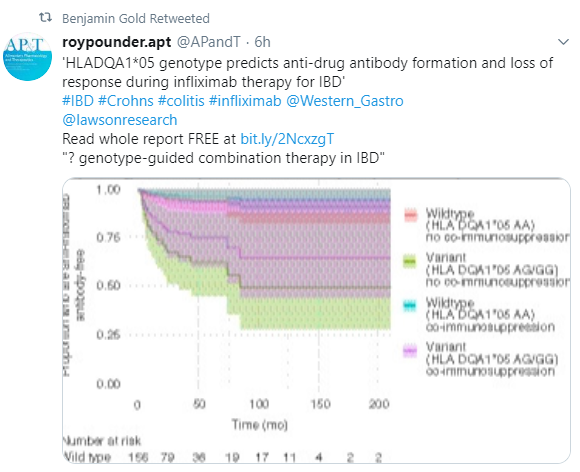
A recent study (A Wilson et al. AP&T 2019; https://doi.org/10.1111/apt.15563) noted that a HLADQA1*05A>G genotype predicts a high risk of developing anti-drug antibodies in patients receiving infliximab.

Here’s a link to the full article:  HLADQA1*05 genotype predicts anti‐drug antibody formation and loss of response during infliximab therapy for inflammatory bowel disease

Here’s the abstract (my highlights in bold):

Background

Anti‐drug antibodies (ADAs) are a leading contributor to infliximab loss of response and adverse drug events. It is not feasible to identify patients at risk of antibody formation before initiating infliximab. The genetic variation HLADQA1*05 (rs2097432) has been linked to infliximab antibody formation in Crohn’s disease (CD).

Aims

To evaluate the association between HLADQA1*05 and infliximab antibody formation, infliximab loss of response, treatment discontinuation and adverse drug events in patients with inflammatory bowel disease (IBD)

Methods

In a retrospective cohort study, infliximab‐exposed patients with IBD (n = 262) were screened for the genetic variation, HLADQA1*05A>G (rs2097432). Risk of infliximab ADA formation, infliximab loss of response, adverse events and discontinuation were assessed in wild‐type (GG) and variant‐carrying (AG or AA) individuals.

Results

Forty per cent of all participants were HLADQA1*05A>G variant carriers, with 79% of participants with infliximab antibodies carrying at least one variant allele. The risk of infliximab antibody formation was higher in HLADQA1*05A>G variant carriers (adjusted HR = 7.29, 95% confidence interval (CI) = 2.97‐17.191, P = 1.46 × 10−5) independent of age, sex, weight, dose and co‐immunosuppression with an immunomodulator. Variant carrier status was associated with an increased risk of infliximab loss of response (adjusted HR = 2.34, 95% CI = 1.41‐3.88, P = .001) and discontinuation (adjusted HR = 2.27, 95% CI = 1.46‐3.43, P = 2.53 × 10−4) although not with infliximab‐associated adverse drug events.

Conclusions

HLADQA1*05 is independently associated with a high risk of infliximab antibody formation in addition to infliximab loss of response and treatment discontinuation. There may be a role for genotype‐guided application of combination therapy in IBD.

Related blog posts:

IBD Updates November 2019

M Lowenberg et al. Gastroenterol 2019; 157: 997-1006. This LOVE-CD study, a prospective study with 110 patients with active Crohn’s disease, found that treatment with vedolizumab resulted in 29% and 31% corticosteroid-free clinical remission at weeks 26 and 52 respectively (CDAI <150).  Endoscopic remission, based on intent-to-treat analysis, was 33% and 36% at weeks 26 and 52.  Serum vedolizumab levels above 10 mg/L at week 22 were associated with endoscopic remission at week 26.

S Danese et al. Gastroenterol 2019; 157: 1007-18.  This VERSIFY trial, a phase 3b, open-label, single-group study of 101 patients with Crohn’s disease, found that treatment with vedolizumab resulted in 11.9% and 17.9%  endoscopic remission at week 26 and 52 respectively. Remission by MRE was 21.9% and 38.1% at those respective time points. No notable safety issues were reported.

N Khan et al. Clin Gastroenterol 2019; 17: 2262-8. Using a retrospective cohort of 54,919 patients with IBD followed by the VA System (2000-2018), the authors identified 467 patients with incident squamous cell cancer (SCC); median age ~70 years.  11 patients with SCC died from related-complications.  In this group, 8 had been exposed to thiopurines.   Thus, exposure to thiopurines increased mortality related to SCC compared to those exposed to mesalamine therapy, though the absolute risk among the entire cohort was less than 1 in 5000.  My take: Long-term use of thiopurines should be paired with dermatology evaluation and good skin care.

Pics from Mechandise Mart Light Show, Chicago

What is the Calprotectin Threshold for Disease Progression in Crohn’s Disease?

A recent retrospective study (NA Kennedy et al. Clin Gastroenterol Hepatol 2019; 17: 2269-76) with 918 patients with Crohn’s disease (CD) examined calprotectin levels and disease progression. Median followup was 50.6 months.

Key findings:

  • A calprotectin level cut-off of 115 mcg/g was identified as optimal for separation of those with and without disease disease progression.
  • The authors noted: “Several studies have identified a cut-off value of 250 mcg/g as being useful to distinguish active from inactive disease.  In the present study,…a lower threshold of 115 mcg/g (was identified) suggesting that lower levels of inflammatory activity still may be associated with an adverse outcome.”
  • The authors’ figure 2, as estimated by the empiric transition matrix method, shows disease progression over 30 years.  At that point,  the groups were nearly equally divide between stricturing disease, penetrating disease and inflammatory disease; in contrast at disease onset, ~80% had inflammatory disease behavior.

My take: As more effective therapies have become available, our goals for disease control have changed and focus on altering the disease course with more stringent endpoints.  For calprotectin, the lower number (115 compared to 250) indicates a much lower risk for disease progression.

Related blog posts:

Chicago