This retrospective review examined health care utilization within 3 months before and after patients received a constipation action plan (CAP which was implemented in 2019). There were 336 patients who received a CAP and 2812 patients who did not.
Key findings:
There were fewer patient telephone calls for patients who received the CAP (P = 0.0006). The difference in patient electronic messages was not statistically significant (P = 0.09).
There were no differences in UC/emergency department visits or hospitalizations.
Medications for CAP included the following:
Polyethylene glycol 3350, Senna, Milk of Magnesia, Magnesium Citrate, Lactulose, Bisacodyl (tablets, suppository, enema), Normal saline enema, Glycerin suppository, and Sodium phosphate enema
My take: A CAP likely helps educate and empower families on how to manage their child’s symptoms. In this study, it resulted in fewer phone calls (& trend of less electronic messages). Better education is likely to help with patient outcomes even if this is difficult to prove in a retrospective study. This action plan appears easier to understand than a previous CAP, and uses the Red Zone as the cleanout section. Related blog post:Pictographic Constipation Action Plan (2021)
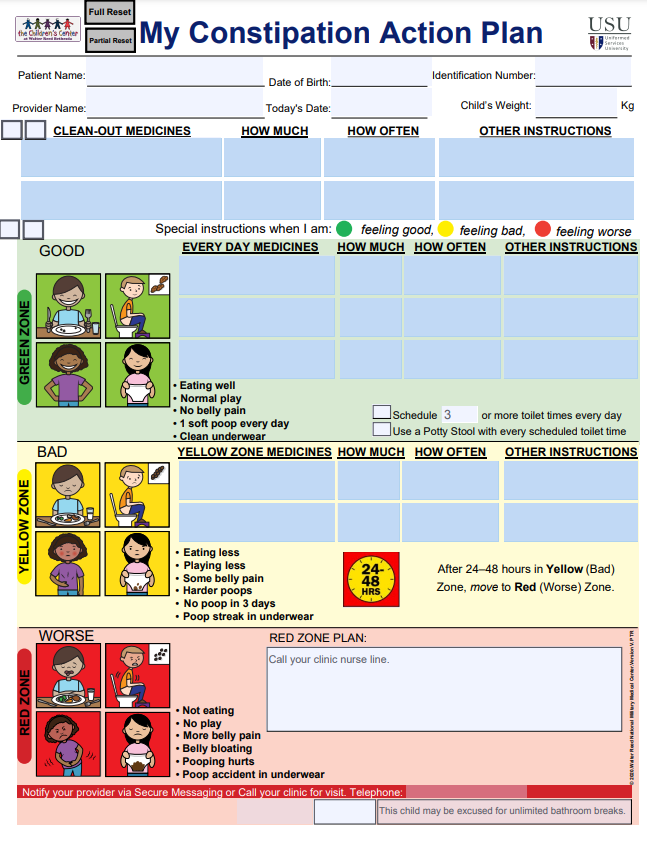
This is a sample of the institution’s constipation action plan (similar to Figure 1) shared by the author.
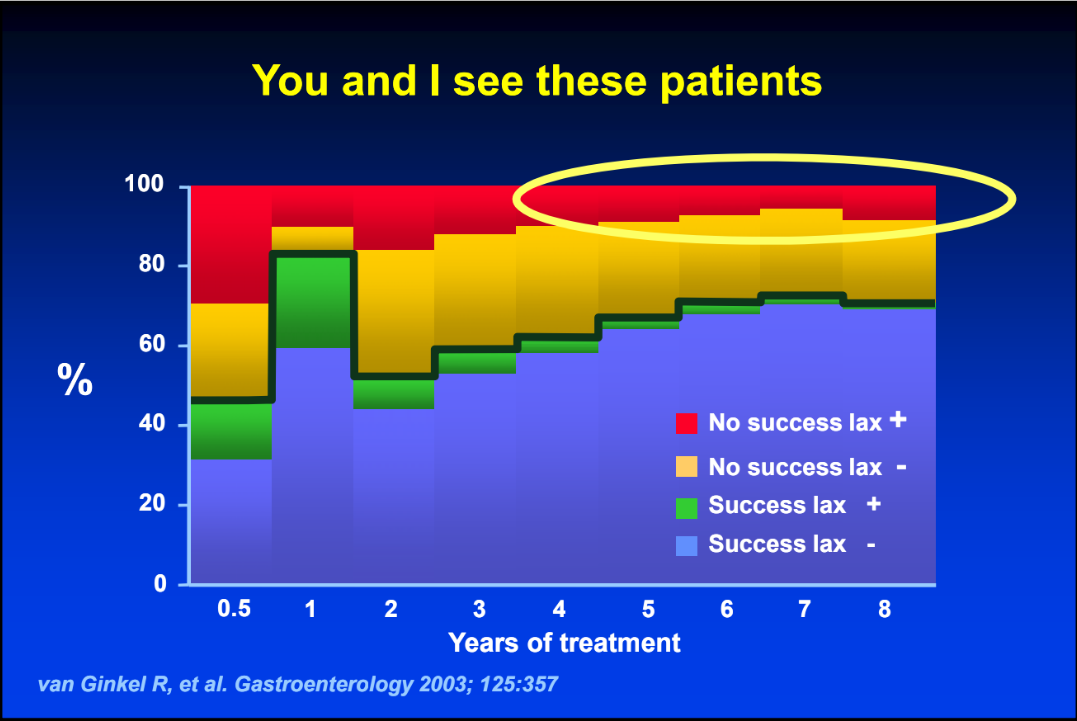
Oral small molecultes in IBD. Anne Griffiths, MDJudith Kelsen, Very early onset IBDVEO EvaluationVEO TreatmentsJeremy Adler and Treat to Target for IBDJeremy Adler and Treat to Target for IBDJeremy Adler and Treat to Target for IBDJeremy Adler and Treat to Target for IBDJeremy Adler and Treat to Target for IBDTimothy Sentongo and Growth and Nutrition Issues in the NICUMaureen Leonard and Gluten-Related Disorders UpdateMaureen Leonard and Gluten-Related Disorders UpdateMaureen Leonard and Gluten-Related Disorders UpdateMaureen Leonard and Gluten-Related Disorders UpdateRachel Rosen and Esophageal Motor DisordersKatja Kovacic and Functional NauseaThis study was 20 yrs ago -we can do better today
Disclaimer: This blog, gutsandgrowth, assumes no responsibility for any use or operation of any method, product, instruction, concept or idea contained in the material herein or for any injury or damage to persons or property (whether products liability, negligence or otherwise) resulting from such use or operation. These blog posts are for educational purposes only. Specific dosing of medications (along with potential adverse effects) should be confirmed by prescribing physician. Because of rapid advances in the medical sciences, the gutsandgrowth blog cautions that independent verification should be made of diagnosis and drug dosages. The reader is solely responsible for the conduct of any suggested test or procedure. This content is not a substitute for medical advice, diagnosis or treatment provided by a qualified healthcare provider. Always seek the advice of your physician or other qualified health provider with any questions you may have regarding a condition.
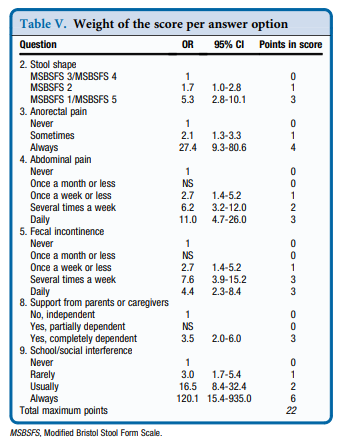
This report describes the “newly developed and validated PBMST (Pediatric Bowel Management Scoring Tool) is a reliable tool for evaluating bowel management strategies in children with constipation.”
Key finding:
“This study shows that use of the PBMST (see below) can better guide management of childhood constipation, with its fair reproducibility indicating that it is stable over a specified time period. Indeed, consistent use of the PBMST can objectify the patient’s clinical condition over a longer period. Consequently, the score provides feedback regarding the effect of the applied bowel management strategy for each individual patient.”
I am happy to say that this is the last nightcall that I will have this year!
Today, I’ve compiled some of my favorite posts from the past year. I started this blog a little more than 10 years ago. I am grateful for the encouragement/suggestions from many people to help make this blog better. Also, I want to wish everyone a Happy New Year.
At a recent pharmacy committee meeting, we discussed the potential use of enteral naloxone for ICU patients with opioid-induced constipation.
Background:
Opioids bind to mu receptors within the gastrointestinal tract. Activation of the bowel opioid receptors slow gastric transit time, decreases gastric secretions, and reduces intestinal muscle tone leading to enhanced fluid absorption and subsequently dry and hard stools.
Naloxone (Narcan®) solution for oral/enteral use
Mechanism of action:
Pure opioid antagonist that competes and displaces opioid at opioid receptor sites
As an antidote – pure opioid antagonist that competes and displaces opioids at opioid receptor sites
As an oral agent – Enteral administration of naloxone blocks opioid action at the intestinal receptor level but has low systemic bioavailability (if dosed properly) due to marked hepatic first-pass metabolism. As a result, oral naloxone only binds strong enough for a pharmacologic response at opioid receptors in the gastrointestinal tract without reducing the central effect of the opioid and precipitating systemic withdrawal.
Potential alternatives:
Methylnaltrexone (Relistor®) SQ 12mg/0.6mL (much more expensive)
Rectal treatments: Bisacodyl (Dulcolax®), Enema
Oral constipation medications:
Polyethylene glycol (Miralax®)
Bisacodyl (Dulcolax®)
Senna (Senokot®)
Administration:
Dose recommendations: 10 – 20 mcg/kg dose PO q8h (max dose: 400mcg) for 5 – 7 days, then re-evaluate therapy
Oral/enteral dose should be not administered intravenously to prevent systemic effect and withdrawal in patients
My take: Enteral naloxone (IV solution) may be helpful for opioid-induced constipation but caution is needed to assure it is administered enterally and at proper dose.
Some of the research studies:
Tofil N, Benner K, Faro S, Winkler M. The Use of Enteral Naloxone to Treat Opioid-Induced Constipation in a Pediatric Intensive Care Unit. Pediatr Crit Care Med. 2006;7(3):254-272.
Akkawi R, Eksborg S, Andersson A, et al. Effect of Oral Naloxone Hydrochloride on Gastrointestinal Transit in Premature Infants Treated with Morphine. Acta Paediatrica.2008;98:442-447
Liu M, Wittbrodt E. Low-Dose Oral Naloxone Reverses Opioid-Induced Constipation and Analgesia. J Pain Symptom Manage. 2002;23(1):48-53
Friedman J, Dello Buono F. Opioid antagonist in the Treatment of Opioid-Induced Constipation and Pruritus. Ann Pharmcother. 2001;35:85-91
Meissner W, Schmidt U, Hartmann M, et al. Oral Naloxone Reverses Opioid-Associated Constipation. Pain. 2000;84:105-109
Disclaimer: This blog, gutsandgrowth, assumes no responsibility for any use or operation of any method, product, instruction, concept or idea contained in the material herein or for any injury or damage to persons or property (whether products liability, negligence or otherwise) resulting from such use or operation. These blog posts are for educational purposes only. Specific dosing of medications (along with potential adverse effects) should be confirmed by prescribing physician. Because of rapid advances in the medical sciences, the gutsandgrowth blog cautions that independent verification should be made of diagnosis and drug dosages. The reader is solely responsible for the conduct of any suggested test or procedure. This content is not a substitute for medical advice, diagnosis or treatment provided by a qualified healthcare provider. Always seek the advice of your physician or other qualified health provider with any questions you may have regarding a condition.
Key finding: 606 patients were randomized to treatment (placebo: n=202; lubiprostone: n=404). No statistically significant difference in overall SBM (spontaneous bowel movement) response rate was observed between the lubiprostone and placebo groups (18.5% vs 14.4%; P=.2245).
A recent study (PT Reeves et al. J Pediatr 2021; 229: 118-126. Full text link: Development and Assessment of a Pictographic Pediatric Constipation Action Plan) highlighted patient education efforts. “This study focused on the design and assessment of a low literacy pictographic CAP for the care of functional constipation in children.”
My take: I agree with the authors that a simple plan like this has “the potential to become an important tool to be used in the care of children with functional constipation, improving both quality-of-care and clinical outcomes.”
This QR code provides 9 minute explanation of constipation and action plan:
Disclaimer: This blog, gutsandgrowth, assumes no responsibility for any use or operation of any method, product, instruction, concept or idea contained in the material herein or for any injury or damage to persons or property (whether products liability, negligence or otherwise) resulting from such use or operation. These blog posts are for educational purposes only. Specific dosing of medications (along with potential adverse effects) should be confirmed by prescribing physician. Because of rapid advances in the medical sciences, the gutsandgrowth blog cautions that independent verification should be made of diagnosis and drug dosages. The reader is solely responsible for the conduct of any suggested test or procedure. This content is not a substitute for medical advice, diagnosis or treatment provided by a qualified healthcare provider. Always seek the advice of your physician or other qualified health provider with any questions you may have regarding a condition
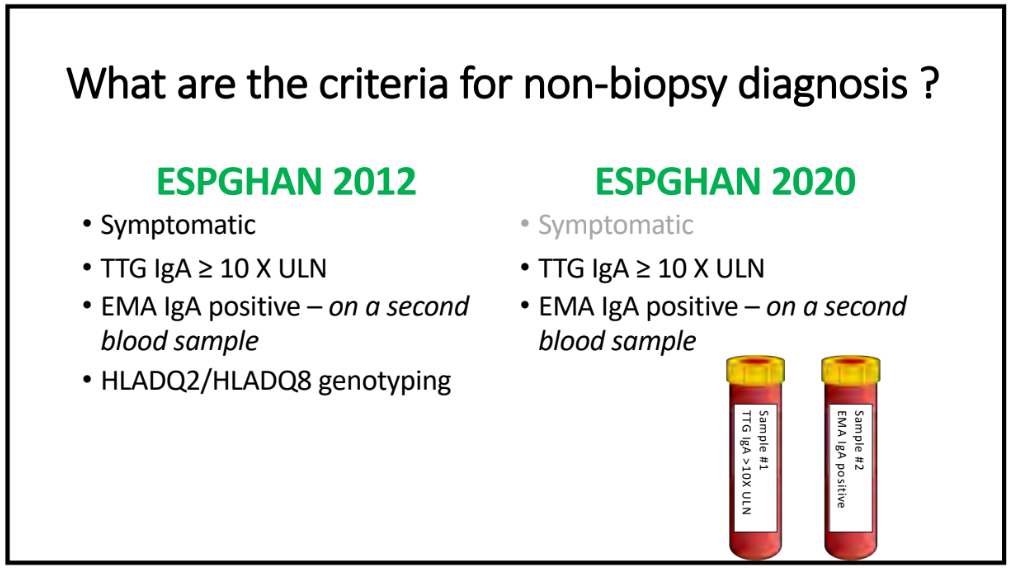
A recent study (AC Fifi et al. J Pediatr 2020; 227: 77-80.Full text PDF: Celiac Disease in Children with Functional Constipation: A School-Based Multicity Study) shows that celiac disease was not more prevalent in Colombian children with functional constipation(n=203) than in matched healthy controls (n=419). Patients were recruited from public schools.
Key finding:
The overall prevalence of celiac disease in the entire cohort was 0.6%. Of those with functional constipation, 1 (0.5%) was diagnosed with celiac disease, and 3 (0.7%) of the control patients
The authors note that some prior publications (references 11 and 12) have found a slight increase risk of celiac disease in children with constipation.
My take: In children with functional constipation, the yield from testing for celiac disease is very low and probably not significantly greater than the general population. In children with irritable bowel syndrome (which is often confused with constipation), the yield is probably a bit higher.
I want to thank all of you who take an interest in my blog, particularly those who give suggestions, references, and encouragement. The following posts were the most popular from the past year.
From a randomized (Virtual) ACG 2020 study from Samuel W. Chey and colleagues (University of Michigan), n=79 adults:
“All three treatments improved complete spontaneous bowel movement (P .003). Prunes demonstrated the largest magnitude of response at 67% vs. 64% for psyllium vs. 45% for Kiwi fruit”
“The highest proportion of participants – 68% – reported treatment satisfaction with kiwifruit while similar proportions of those receiving prunes and psyllium – 48% – reported satisfaction”
“The kiwi group had the lowest proportion of participants reporting treatment dissatisfaction at 7%….Participants receiving prunes and psyllium were more likely to report abdominal pain and bloating than those receiving kiwi”